The Data
A state health department is considering a new diabetes prevention program. The evidence suggests the program works, but with substantial uncertainty. The effect could be large, modest, or even zero. (Data are simulated for illustration.)
Next: What happens if we implement the program now? What happens if we wait? The answer depends on which scenario turns out to be true.
Decision Under Uncertainty
Every decision carries risk. Implementing a program that doesn't work wastes resources. Waiting to implement a program that works delays health benefits. The expected value calculation weighs these trade-offs.
Implement Now
Act on current evidenceWait for Better Evidence
Delay decision by 2 yearsExpected Value of a Decision
The expected value is the probability-weighted average of all possible outcomes. It accounts for both:
- Upside risk: The chance of gains if the decision is right
- Downside risk: The chance of losses if the decision is wrong
In this case, both decisions have positive expected value. But which is higher depends on how uncertain we are and how costly waiting is.
Next: If we could learn the truth before deciding, how much would that information be worth? This is the Expected Value of Perfect Information.
EVPI Explained
The Expected Value of Perfect Information (EVPI) tells us the maximum we should spend on research. It's the difference between deciding with perfect knowledge and deciding under uncertainty.
Next: How do the key parameters affect the value of information? Explore interactively to build intuition.
Interactive Value of Information
Adjust the parameters below to see how uncertainty, costs, and population size affect the optimal decision and the value of additional research.
Next: What's the key insight for health economists? "Wait for better evidence" is itself a decision that must be evaluated.
Key Insight
Waiting for more evidence has real costs. Every day of delay means foregone benefits for people who would have been helped. Economics treats the decision to wait as itself a choice with consequences.
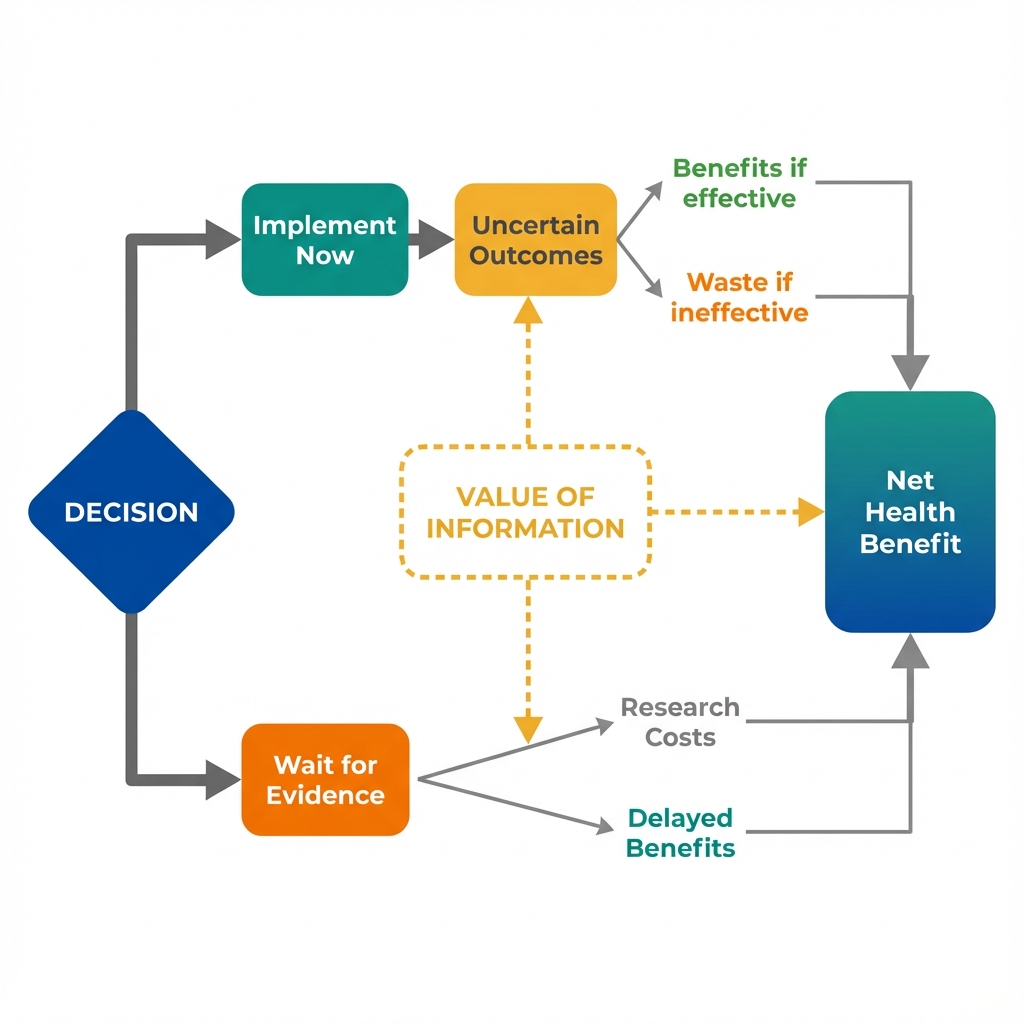
The decision to wait is itself a choice with expected costs and benefits. VOI analysis makes these trade-offs explicit.
Questions Economists Ask About Evidence and Action
Value of Information Analysis
Value of Information (VOI) quantifies how much additional research is worth. It provides:
- EVPI (Expected Value of Perfect Information): Upper bound on what any research could be worth
- EVPPI (Partial Perfect Information): Value of resolving uncertainty about a specific parameter
- EVSI (Sample Information): Value of a specific study with a specific sample size
VOI transforms vague calls for "more research" into precise questions about which research, how much, and whether it's worth the investment.
Key Takeaway
"Wait for better evidence" is not a neutral position. It's a decision with real costs: delayed benefits for patients, continued spending on possibly inferior alternatives, and the expense of the research itself. Value of Information analysis makes these trade-offs explicit and quantifiable. The goal isn't to eliminate uncertainty before acting. The goal is to act wisely given the uncertainty we face. This is what economists mean by "decision-making under uncertainty."