The Data
A county health department must choose between two diabetes prevention programs. Both have been evaluated. One delivers more health per dollar spent. The other costs less overall. Which should they fund? (Data are simulated for illustration.)
County Health Department Budget
The department has allocated funds for a new diabetes prevention initiative. Whatever they choose must fit within this envelope.
Program A Intensive Lifestyle Intervention
Verdict: Highly cost-effective ($16,535/QALY is well below typical thresholds) and fits within budget.
Program B Community Health Worker Outreach
Verdict: Still cost-effective ($26,667/QALY meets thresholds), lower total cost, reaches more people.
Both programs are "cost-effective" by standard criteria.
So why does it matter which one we choose? Because cost-effectiveness ratios alone do not tell us what we must give up to afford either option.
BIA Explained
Cost-effectiveness analysis asks "Is this a good use of money?" Budget impact analysis asks "Can we actually afford it?" These questions have different answers, and both matter for real decisions.
What Is Budget Impact Analysis?
Budget Impact Analysis (BIA) estimates the financial consequences of adopting a new intervention within a specific budget context. It answers:
- How much will total spending change?
- When will costs be incurred (Year 1 vs. Year 5)?
- What existing programs might need to be cut or reduced?
- Is this feasible given current constraints?
Unlike cost-effectiveness, BIA does not compare health gains to costs. It simply asks whether the organization can pay for what it wants to do.
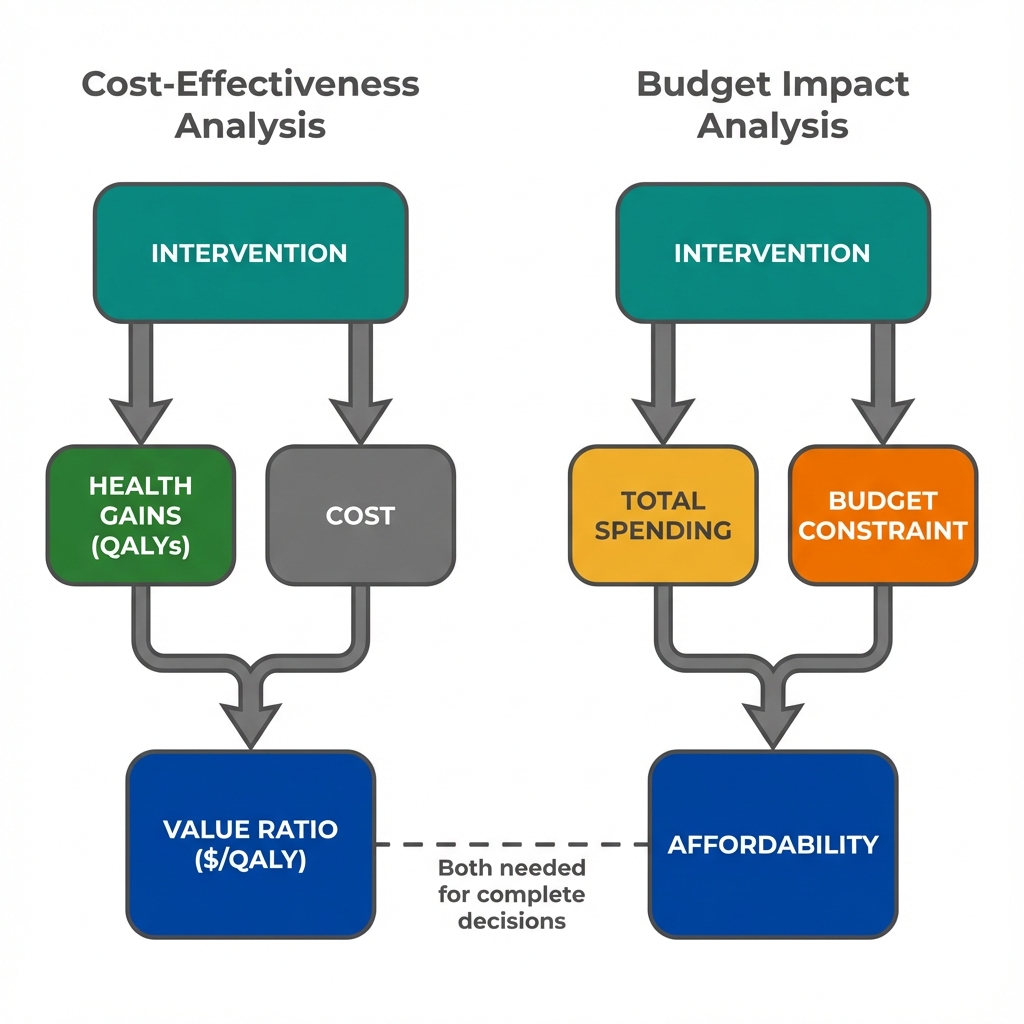
CEA and BIA answer different questions. Both are needed for complete decision-making.
Understanding both analyses reveals hidden tradeoffs.
What happens when a highly cost-effective program is too expensive, or when an affordable program wastes resources?
The Tradeoffs
Programs can be cost-effective but unaffordable, or affordable but wasteful. Each combination creates a different policy challenge. Economists map these possibilities to clarify what each decision truly costs.
The Cost-Effectiveness vs. Affordability Matrix
Cost-Effective + Affordable
The program delivers good value per dollar and total costs fit within available budgets. This is the goal.
Cost-Effective + Unaffordable
The program delivers excellent value, but the total price tag exceeds what the organization can spend. This forces difficult choices.
Not Cost-Effective + Affordable
The program is cheap enough to implement, but the health gains per dollar are poor. Money could be better spent elsewhere.
Not Cost-Effective + Unaffordable
The program is both poor value and too expensive. This is the clearest case for rejection.
Real decisions require exploring both dimensions simultaneously.
What if you could adjust the scale or intensity of a program to change its budget impact while preserving cost-effectiveness?
Interactive Budget
Adjust program scale and intensity to see how budget impact changes. Notice that cost-effectiveness ratios stay constant while total costs fluctuate. This is the core insight: value and affordability are independent.
Scaling changes total cost but not value per dollar.
This reveals why economists insist on answering both questions: a program's worth depends on both its efficiency and its feasibility in context.
Key Insight
These questions help clarify why "it works" and "we should fund it" are separate claims. They reveal the gap between knowing something is valuable and knowing whether we can actually do it.
Why doesn't cost-effectiveness guarantee adoption?
A $10,000/QALY intervention is excellent value. But if it requires $100M to implement and you have $5M, you cannot adopt it at full scale regardless of its efficiency.
What does "opportunity cost" mean here?
Every dollar spent on one program cannot be spent on another. Budget impact analysis forces you to confront what you give up when you choose.
When do cheap programs waste money?
An affordable program that delivers poor health value consumes budget that could have funded something more effective. Low cost does not equal good investment.
How do time horizons matter?
Some programs have high upfront costs but generate savings later. BIA tracks cash flow over time, revealing whether short-term pain leads to long-term gain.
Concepts Demonstrated in This Lab
Key Takeaway
Cost-effectiveness tells you whether a program is a good use of money. Budget impact tells you whether you can actually afford it. Answering "Is it worth it?" without asking "Can we pay for it?" leads to policies that look good on paper but never get implemented. Economists insist on both questions because real decisions happen under real constraints. Affordability and value are separate tests that programs must pass.